Aug 1, 2008

The Whole Brain Model

"We do not see things as they are, we see things as we are" - The Talmud

Have you noticed that people learn things in different ways? For example, I am a visual learner. I need to see an illustration, photo, or video of something to understand how it works. Someone else might just be able to read a description to understand it. And another person needs to be able to manipulate it before it makes sense to her.

This relates to the concept of Multiple Intelligences and it shows that people have unique learning styles. Courses need to evolve from one-dimensional presentations to a more flexible style that can really reach a broader audience of learners.

The Whole Brain Model
The Whole Brain Model is based on the concept that our different modes of learning are distributed among the four quadrants of the brain. Each quadrant is focused on specific thinking processes. However while you may be stronger in one of the quadrants (I fluctuate between A and D), you have some degree of all quadrant traits in you.
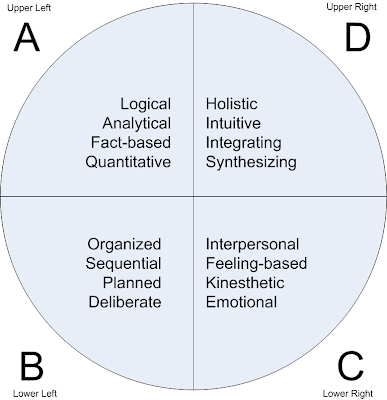

These connections between the four quadrants are there, but they may be weak. So when faced with a learning method that is not a learner's dominant style, there may be uncomfortable, unpracticed or frustrating experiences. On the other end of the spectrum, if you cater only to the dominant learning style, then there is less of a challenge and the training becomes boring.

The idea is to find that balance between boring the learner and anxiety.


Source: Biech, E. (Ed.). (2008). ASTD handbook for workplace learning professionals. Alexandria, VA: ASTD Press.

Teach them how to think, rather than do

Telling ain't training. It's been said before many times. Yet, many courses still take the approach of 'just tell them what they need to know'.

Well, Cathy Moore brings up a good point when she says "It’s easiest to just tell them what to do, but what we need to do is to teach them how to think."

Adult learners want to know that the time they invest in training will be immediately valuable to their job. Part of accomplishing that is to present scenarios that do not portray solid black-or-white instances. Let there be some ambiguity, because that's what real life is, right?

Remember, the goal of training is to change behavior. So give learners a chance to make decisions and then show the results of those decisions. Not all of them will be the correct ones, but by understanding why it was incorrect and how to improve upon it will be more effective than just clicking through multiple choice quizzes.

Jul 22, 2008

What Everybody Ought To Know About Instructional Design

Article: What Everybody Ought to Know About Instructional Design

It answers the question “What is the role of the instructional designer? And how do I convey that to my clients and subject matter experts?"

The article is worth the read, but I’ll summarize:

  • The instructional designer is to help learners make sense of the new information they get [from e-learning courses].
  • ID’s help the learner focus on very specific pieces of information by providing context and perspective.
  • ID’s help compress the learning process saving time and money.
  • ID’s present a clear and meaningful purpose for the learners.

Jul 8, 2008

When Less Is More

Quite often in the compliance courses, much of the content deals with the history of the different compliance laws, why they were put in place and every other back story. Just how much of that content is necessary when developing a course?
A great article today titled "Build Better e-Learning Courses By Getting Rid of Some of the Content" lists three critical questions to determine which content is 'need to know' versus 'nice to know'.
  1. What is the learner supposed to do at the end of the course? Should they accomplish a specific task or solve a certain problem?
  2. What course content will help the learner meet the course objectives? Sort the content and identify which pieces the learner needs to meet the course goals.
  3. How will the learner use this in the real world? If knowing the chairman of the Department of Justice won't help the learner identify when HIPAA laws are being violated, then don't include it in the course.


The 'need to know' information doesn't need to be ellimated entirely; it just needs to augment the course content instead being the course content. If the learner seeks it out or finds it necessary, it can be available as resource information or links to additonal documentation.

Jul 2, 2008

Measurement Job Aid

As a follow up to my last post, I found a handy 1 page job aid that helps in determining if the measurement tool in an eLearning course is as good as it can be.